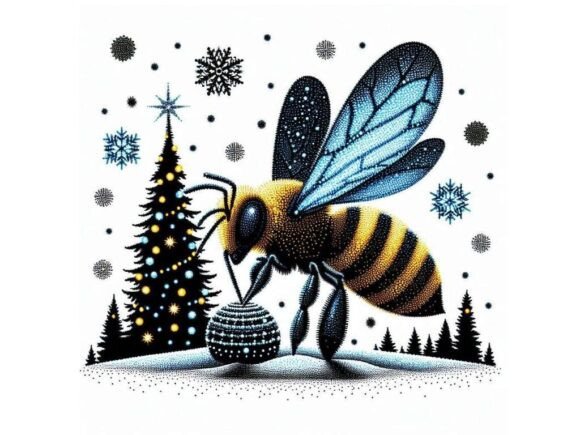
Pointillism Christmas Bee in a Snowy Sce Review
As a designer who spends half my life tweaking stitch density and the other half arguing with clients about thread colorfastness, I don’t just look at an embroidery file; I visualize the finished product on the hoop. When Pointillism Christmas Bee in a Snowy Sce landed in my inbox, my first thought wasn’t about its aesthetic charm—though that is undeniable—but about how it would translate from a digital illustration into tangible textile art. This piece falls squarely into the Illustrations category, which often presents unique challenges for digitizers because illustrative styles rely heavily on negative space and subtle tonal shifts that can easily get lost in dense machine stitching.
The First Impression: Mood and Visual Personality
The moment you open the file, the pointillist style immediately sets a distinct tone. Unlike traditional vector-based embroidery designs that rely on bold outlines and solid fills, this design uses thousands of tiny dots to create form and depth. The mood is whimsical yet refined. It feels less like a mass-produced holiday graphic and more like a boutique item you might find in a high-end craft fair or a curated Etsy shop. The bee itself serves as the focal point, surrounded by a snowy scene that suggests movement and texture without overwhelming the eye.
For designers, the visual personality here is crucial. It strikes a balance between festive cheer and sophisticated minimalism. This isn’t your standard red-and-green Santa clipart. It appeals to buyers who appreciate handcrafted nuance. The layout is clean, allowing the eye to travel naturally across the snowflakes and the bee’s wings. It feels airy, which is a double-edged sword in embroidery: it looks beautiful in a mockup, but it requires careful execution to ensure the "dots" don’t merge into muddy blobs during the stitching process.
Real-World Application: Where This Design Shines
I recently evaluated this design for a potential client project involving custom holiday merchandise. Specifically, I was considering using Pointillism Christmas Bee in a Snowy Sce for a line of embroidered tote bags and baby onesies. Here is how I see it performing in those real-life scenarios.
- Tote Bag Embroidery: This is perhaps the strongest use case. A canvas tote provides a stable, flat surface that allows the intricate dot work to shine. The contrast between the sturdy fabric and the delicate design creates a professional, handmade look. It elevates a simple bag into a statement accessory, perfect for an Etsy seller looking to stand out in the crowded holiday market.
- Baby Apparel: The soft, rounded shapes of the bee and the gentle snowfall make this ideal for baby embroidery. On a white or cream onesie, the design reads as sweet and timeless. It works beautifully as a chest logo or centered on the back. Parents are drawn to designs that feel organic and gentle, and this fits that niche perfectly.
- Holiday Gifts and Personalized Products: Imagine this stitched onto a linen tea towel or a small pillow cover. The pointillist style adds a layer of complexity that makes the gift feel special. It’s not just a holiday decoration; it’s a piece of art. For custom apparel decorators, adding a name in a simple font below the bee could create a stunning personalized family gift.
- Embroidered Patches: If bordered correctly, this design translates well to iron-on patches for denim jackets or backpacks. The detailed nature of the design gives the patch character, making it a standout embroidered patch for youth or adults who want subtle holiday flair.
Technical Considerations and Stitch Performance
However, beauty in a screenshot does not always equal success on the machine. As a reviewer, I must highlight where Pointillism Christmas Bee in a Snowy Sce demands caution. Pointillism relies on the separation of elements. In embroidery, if the stitch density is too high, the threads will push each other apart, causing the image to distort. Conversely, if the spacing is too wide, the fabric shows through, breaking the illusion of the dots.
When evaluating this as a machine embroidery design, you need to pay close attention to the stitch density. The fine details of the bee’s wings and the individual snowflakes require precise placement. I recommend testing this on scrap fabric first, specifically checking how the thread colors interact. Light threads on light backgrounds can disappear, while dark threads on dark fabrics can lose definition. Always inspect small details under bright light to ensure they remain distinct after stitching.
Furthermore, consider the hoop size. While this design likely fits within standard hoops, placing it on curved surfaces like sweatshirt embroidery on shoulders or caps can be tricky. The tension needs to be consistent to prevent puckering, especially around the denser areas of the bee. If you are working with textured fabrics, such as heavy wool or boucle, you may need to adjust the stabilizer choice. A cut-away stabilizer is often best for these types of detailed projects to ensure longevity, especially for items that will undergo frequent washing.
Fabrics and Backgrounds to Avoid
There are certain environments where this design should be used carefully. Avoid thin, stretchy knits unless you have excellent tension control, as the detailed stitches can cause distortion. Dark fabrics can also be challenging; unless you use a high-contrast thread palette, the subtle variations in the pointillist style may flatten out. Additionally, be wary of using this for very small accents or decorative trimmings. The level of detail is meant to be viewed up close, so shrinking it down for a tiny cuff logo might result in a loss of clarity.
Impact on Brand and Customer Trust
For small business owners and craft business operators, the quality of the design directly impacts perceived value. A well-executed pointillist design signals professionalism. It tells the customer that you care about the nuances of your craft. When a buyer sees the intricate work involved in stitching something like Pointillism Christmas Bee in a Snowy Sce, they are more willing to pay a premium price. It enhances the handmade presentation and builds trust in your brand consistency.
In the age of digital printing, embroidery offers texture and depth that prints cannot match. By choosing a design with this level of artistic integrity, you differentiate your products from generic drop-shipped goods. It attracts customers who value uniqueness and artisanal quality. Whether you are listing this as a small shop product or using it for commercial embroidery projects for local businesses, the design adds a layer of sophistication that resonates with modern consumers.
Final Designer Notes
Before committing to production runs, I strongly advise running a black-and-white mockup of the design. This helps you verify that the composition holds up even when color contrast is removed. Check whether the design works for both personal use and commercial projects by reviewing the licensing terms provided with the file. Ensure you have the right to sell finished items made from this digital embroidery file.
Ultimately, Pointillism Christmas Bee in a Snowy Sce is a versatile and charming addition to any designer’s library. It bridges the gap between fine art illustration and practical applique or fill stitch work. With proper testing and attention to detail, it can transform simple garments and accessories into memorable keepsakes. For anyone looking to add a touch of elegant whimsy to their holiday collection, this design is a strong contender. Just remember: the devil is in the details, and in pointillism, the devil is literally made of them. Test thoroughly, choose your threads wisely, and let the craftsmanship speak for itself.